
Laminated glass was once a popular material to use in balcony balustrades.
But, since the amendments added to Approved Document B of The Building Regulations in the wake of the Grenfell Tower disaster, the use of laminated glass has been banned in external walls on all new multi-storey buildings over a certain height in England. This includes its use in balconies.
Thankfully, as of October 2026, the British Government is actively considering easing the ban on laminated glass, creating a potential pathway for its re-introduction. In the likely scenario that the government chooses to ease its restrictions, we may be able to start using laminated glass in balconies once again.
In this article, we’ll explore why laminated glass was banned, what the ongoing consultation means for the construction industry, and what to look for next.
SI 2018/1230, also known as The Building (Amendment) Regulations 2018, was an amendment added to Approved Document B of The Building Regulations 2010.
Focusing specifically on external walls and their “specified attachments” (which includes balconies), it states all materials used in the construction of external elements on a building must be fire rated to European Classification A2-s1, d0 or A1 in accordance with BS EN 13501-1:2007+A1:2009.
The government first proposed SI 2018/1230 on 29 November 2018. It came into force on 21 December 2018. The restrictions originally applied to multi-occupancy, multi-storey residential buildings in England that reached above 18m, but on 1 December 2022, the government extended the restrictions to any residential building with a floor 11m or more above ground level.
The restrictions do not apply to buildings in Wales, nor do they apply in Scotland or Northern Ireland.
The new restrictions came about because of the 2017 Grenfell Tower disaster, a tower block fire that claimed the lives of 72 people in London.
In that event, the fire spread rapidly because of external cladding attached to the building façade which was found to be made of highly combustible materials. In the aftermath of the fire, the British Government applied a blanket ban to all combustible materials used on the exterior of buildings.
This effectively banned all forms of timber, wood-plastic composites (WPCs) and plastic components from any part of a balcony, including the balustrades, decking, handrails and core structure, unless specifically included on the exemption list. This, in turn, forced a move towards non-combustible materials for balconies such as aluminium, steel and concrete.
In the case of laminated glass, the problem lies with the polymer interlayers (the high-strength adhesive layers sandwiched between the glass sheets). These are typically made of PVB, EVA and SGP, which are classed as B-s1,d0 materials, putting them in the restricted category.
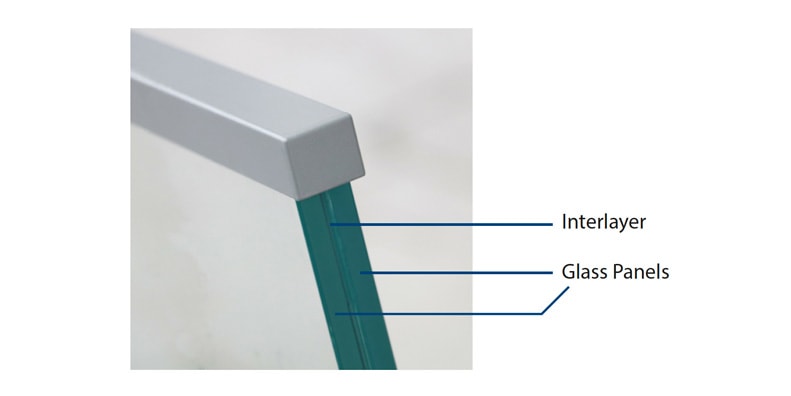
It is incredibly unlikely that these materials would ever contribute to fire load in real world conditions (the fire would need to make it through the external glass layers first). However, the wording of Approved Document B does not make any exceptions.
The construction industry was understandably perplexed by the ban on laminated glass. Multiple bodies (including the UK Industry Task Force) appealed against the ban.
As research from the Building Safety Regulator (BSR) started to reveal the ban was unnecessary, the Health & Safety Executive (HSE) launched a formal consultation to amend Approved Document B, with a stated aim to “revise and update guidance on external wall systems and balconies and review the scope of the ban on combustible materials in and on external walls.”
This consultation opened on 25 March 2026 and ran for just over three months. During this time, industry professionals were invited to submit their views and to provide any independent data or research that could help to empower decision-making in consideration of the future unravelling of the ban.
The basis of the consultation and the potential pathway to undoing the ban is based in three key factors:
With laminated glass banned by Approved Document B, some developers and architects have instead turned to monolithic glass as a substitute material.
However, monolithic glass is much less safe than laminated glass. Not only does it become compromised at much lower temperatures than laminated glass, when it fails it smashes completely leaving an open gap that increases the risk of falling.
In banning laminated glass and forcing a switch to monolithic glass, the government has inadvertently made glass balustrades significantly less safe. At Sapphire, we moved away from monolithic glass as a material in balconies many years ago. We now actively discourage and campaign against its use.
[Monolithic glass fire testing video here]
Despite being banned in the case of balcony balustrading, laminated glass remains a viable material for use in external windows and doors.
This inconsistency highlights the crux of the issue, which is the wording on Approved Document B. Since doors and windows are not classed as part of an external wall or included within the remit of a ‘specified attachment’, they are able to escape the ban.
The implication is that, if balconies were classed in their own category (like doors and windows), they would not be subject to the same blanket ban.
Since the ban was first introduced, new research has come to light that has helped to demonstrate the actual severity of the risk of laminated glass in relation to how fire spreads across multi-storey balconies.
Having taken this research into account, the government has suggested that it is open to moving away from a blanket ban towards a facts-based, risk-managed approach.
Laminated glass is a highly popular material for balcony balustrading both in the UK and internationally. At Sapphire, we still manufacture laminated glass balconies for other international markets – we’ve found it is particularly popular in Ireland and Canada.
As a solid material, laminated glass provides exceptional wind proofing and can also support in sound proofing, making the balcony area more comfortable and inviting for residents. Being transparent, it still allows for uninterrupted views.
It is also a highly versatile and attractive material, which can be tinted or coloured to achieve a desired aesthetic and enhance the overall look of a building façade. At certain angles, laminated glass captures and reflects sunlight, giving the building a pleasant sheen that adds depth to the design.
But perhaps most importantly, laminated glass is popular because it is a sturdy and safe material. The inner layer of plastic adhesive between the two sheets of glass makes laminated glass resilient to shattering, as this layer can hold the glass together if one of the panes breaks.
At Sapphire, we support reversing of the ban on laminated glass in England and hope to see this material permitted once again for use in balcony balustrading.
We believe laminated glass is a safe, robust and versatile material that is ideal in the construction of high-performance balconies, something we have proved through countless laminated glass projects around the world. We do not agree that laminated glass presents a significant fire risk, instead believing that the positives of choosing laminated glass far outweigh the risks.
We have already contributed to the government’s consultation and stated our position as being fully in favour of re-assessing the ban in line with a risk-based approach.
Until that time, we will continue to respect the ban on laminated glass and ensure that all materials used in our balcony system are fire rated to European Classification A2-s1, d0 or A1 standards.
For more information and further updates regarding the laminated glass consultation, be sure to follow this page.